'The truth is ... anthropology was born in the museum ...' [Chapman, 1981: iii]
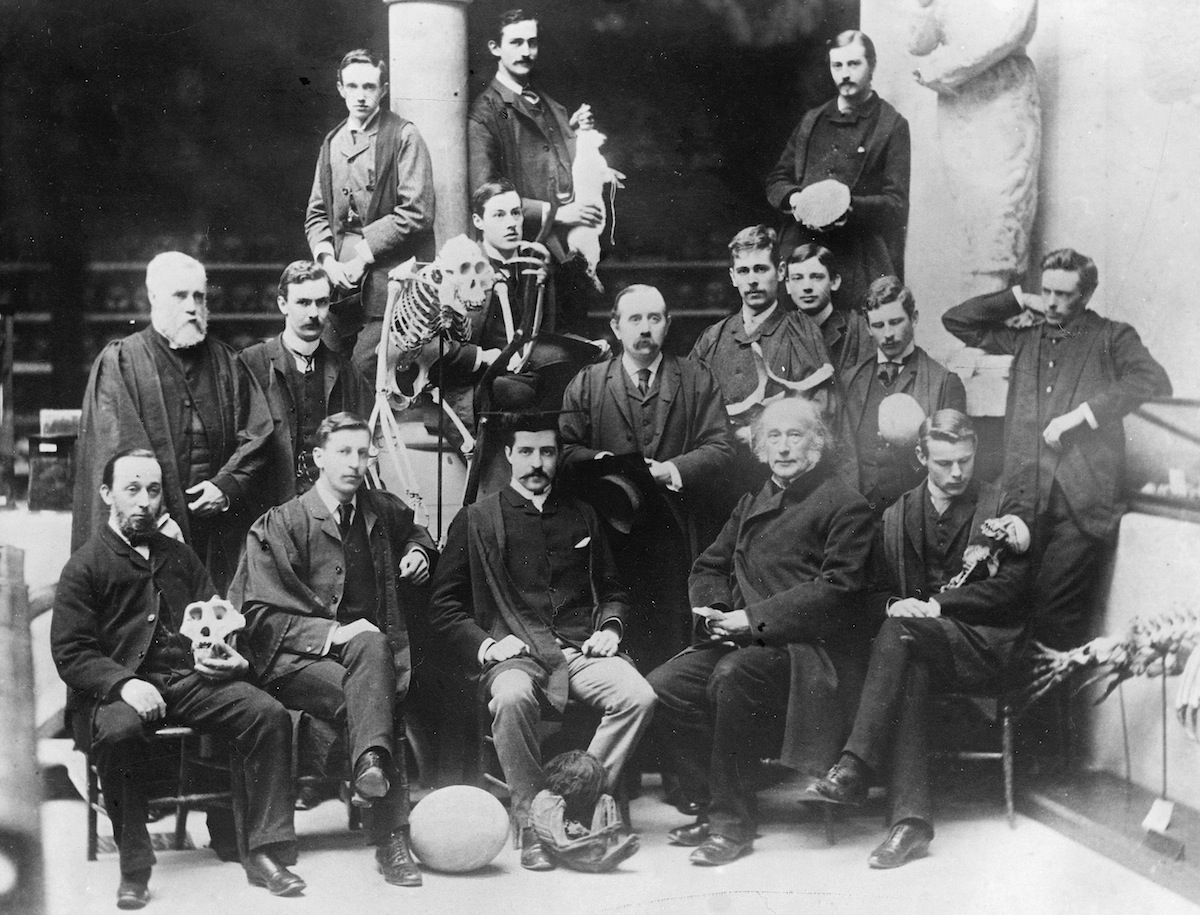 Oxford University Museum staff and students, including Balfour, Moseley, Spencer and Acland, in 1884. 1998.267.85This is a website about the development of museum anthropology as a discipline, and about the set of related museum artefacts, at the University of Oxford during the nineteenth and early twentieth centuries. It provides links to research data, archival resources and transcriptions helpful to any scholars interested in the topic.
This website is an access point for data relating to the history of museum anthropology at the University of Oxford including the development of anthropological or ethnographic collections at the University before the formal discipline of anthropology was recognised. Another focus is on the individuals who contributed to the development of museum anthropology at Oxford, the founding of the Pitt Rivers Museum and establishment of the first paid anthropological lecturer-post at a British university, filled by Edward Burnett Tylor.
 Crania displays in the Oxford University Museum before 1887 [Photograph courtesy of Zoological Collections, OUMNH]The initial project and website was funded by the John Fell Oxford University Press Research Fund 2012-13. The primary investigator for that project was Jeremy Coote and Alison Petch was the researcher. The project ran from 1 September 2012 to end August 2013. The same project team also worked on a three-year Leverhulme Trust-funded project, Rethinking Pitt-Rivers (2009-2012). That project website contains much useful information for scholars interested in the development of museum anthropology and archaeology in the nineteenth century, seen particularly through the foci of Augustus Pitt-Rivers' two collections.
This research has been supported by a wider community of interested scholars including Peter Rivière, Rachel McGoff and staff from the five main institutions whose resources have been included--the Pitt Rivers Museum, Ashmolean Museum, Bodleian Library, University of Oxford Archives, Oxford University Museum of Natural History and other archives.
Please send any feedback about this site or its contents to This email address is being protected from spambots. You need JavaScript enabled to view it.. You can find previous feedback about this website here.
Alison Petch [AP] and Jeremy Coote [JC], Pitt Rivers Museum, University of Oxford.
[First written September 2012, altered January 2014; updated regularly ever since]
Please note that the first photograph on this home page shows many of the key players in the story told by this website. The date of the photograph is taken from the copy of the image used in the book 'Spencer's Last Journey' by Marett and Penniman, where the image is captioned 'The Morphological Laboratory, Oxford, 1884'. It was reproduced by the kindness of G.C. Bourne and H. Balfour (both shown in the photo). In the list of illustrations this was described as 'Group taken in the University Museum at Oxford in 1884'. Presumably Balfour's copy of the image was the one now held by the Pitt Rivers Museum. The caption for the image in 'Spencer's Last Journey' identified the people photographed as: From top left: E.D.Y. Pode [?Poole], H. Balfour, G.H. Fowler, W.L. Sclater, F.E. Lewin, Rev. H. Johnson, S.J. Hickson, W.E. Roth, H.Y. Oldham, William Hine, W.B. Spencer, G.C. Bourne, Dr H.W. Acland and J.G. Ogle. In front of Gilbert Bourne, on the floor, was a Peruvian child mummy, from a necropolis at Ancon in the Lima region [1886.2.19], now in the care of the Pitt Rivers Museum. This mummy was collected in Peru by Commander William Alison Dyke Acland, Royal Navy (1847-1924). He was the eldest son of Henry Acland, who was also in the photograph. This mummy was one of the ones mentioned in a note in the 'Oxford University Gazette' vol. XIII no. 436, 28 November 1882: 'Donation to the University Museum. The Delegates of the Museum announce that four Peruvian Mummies, from Angon [sic] near Lima, presented by Commander W. Acland, R.N., have been opened and examined; and that a series of objects of ethnological interest obtained from them are now on view in the University Museum. These objects comprise children's toys, grotesque ornaments, articles of food, and specimens of coloured fabrics, with patterns and figures of animals, characteristic of Peruvian art.' (FL 6-2-06). This photograph showed the mummy before it was transferred from the University Museum to the Pitt Rivers Museum in 1885-6.
The second photograph was shot before 1887, and shows the cranial displays at the Oxford University Museum, including a Tibetan vessel which is now in the Pitt Rivers Museum [1887.1.589] (see here for more information about this image).
Throughout the website the top strip image on each page shows part of two images taken of the interior of the Pitt Rivers Museum at Oxford during its early years at the end of the 19th and beginning of the 20th century.The two images are 1998.267.280.1 and part of another image referenced '64 3 10' whose provenance and date cannot, at present, be tracked down.