To search the RPR site click here
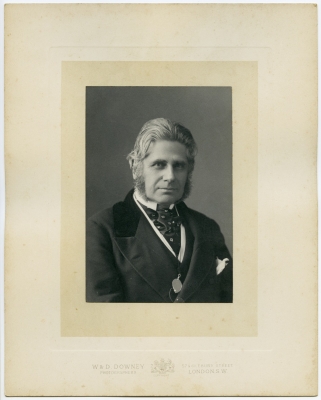 Augustus Henry Lane Fox Pitt-Rivers (1827-1900) was a soldier and collector, interested in anthropology and archaeology. This website is about him, and his collections.
Pitt-Rivers set himself an enormous task which he spent most of his life trying to achieve. Through the acquisition of comprehensive collections from the early 1850s onwards, he wished to make clear the human development of technologies and material culture. He used the objects in his collections as tools in his study of archaeology and anthropology. Pitt-Rivers was modest about his achievements, "I look upon my Museum as being in no way an exception from the ordinary laws affecting all human affairs in regard to development, and that so far from considering it perfect as it is, I cannot conceive any idea of finality in a Museum of the kind." [Letter to Tylor, 5.2.1883, L106 Salisbury and South Wiltshire Museum Pitt-Rivers Papers]
Until the Rethinking Pitt-Rivers project the full extent of Pitt-Rivers' collections has never been known but it is now clear that during his lifetime he probably owned in excess of 50,000 separate artefacts. The first half of these collections was donated to the University of Oxford in 1884 and founded the Pitt Rivers Museum. His son-in-law and colleague, John Lubbock, described this first collection as "perhaps one of the finest collections in the world". [Hansard, Education Science & Art HC Deb 8.8.1881 vol 264 cc1300-42] Edward Burnett Tylor, another colleague of Pitt-Rivers and closely associated with the founding collection in its early years at Oxford, described it as 'one of the best contributions made by Englishmen to the study of culture.' [quoted in Chapman, 1981: 385] He then acquired a second, separate, collection after 1880 (similar in size and content to his first), which he displayed at his private museum in Farnham, Dorset. This museum was eventually closed in the 1960s and the second collection has now been sold and dispersed throughout the world.
The Leverhulme Trust has generously funded two research projects about Pitt-Rivers' collections at the Pitt Rivers Museum. The first ran from 1995 to 1998 and resulted in the compilation of the first comprehensive computerised catalogue of the founding collection of the Pitt Rivers Museum. The second Rethinking Pitt-Rivers project ran from September 2009 until the end of August 2012 and funded this website (amongst other things). The website started at the very beginning of the project and aimed to provide access to as much of the raw project research as possible. Since the completion of the project, new information has continued to be added as it has been acquired, so visitors are encouraged to continue to revisit the site.
During the Rethinking Pitt-Rivers project Pitt-Rivers' collections and all the published and unpublished writing by and about him were surveyed: and his life and work were re-examined in the light of this new knowledge. You can find information about all the objects in his collections by selecting the 'Databases' link on the right hand menu. Statistics based on these collections are provided here. There are a wide range of articles about all aspects of his life, work and collections available via the 'Articles' link. A series of papers, written by a variety of different people, about specific artefacts from his collections can be found under the heading of Objects Biographies. In addition information is available about his art collection and his library, the progress reports and news about the project.
The work has been greatly helped, enhanced and supported by Salisbury and South Wiltshire Museum (who kindly lent their Pitt-Rivers papers to the Pitt Rivers Museum for the second half of the project); and Cambridge University Library, who hold the catalogue of the second collection; and (last but not least) Anthony Pitt-Rivers, the General's great-grandson. This project has attracted a great deal of scholarly interest and generous support from many colleagues. A diversity of other scholars generously gave their time, effort and fruits of their labour towards this project. So, as well as the primary researchers, a wider team of researchers and volunteers was formed; to find out more about them, see here. We are also most grateful to every member of this wider team for their support, especially Peter Rivière and Rachel McGoff who have provided much valuable support since the project began.
We are indebted to Bill Chapman who agreed to allow us to make available via this website his 1981 D.Phil thesis, Ethnology in the Museum; improved access to this thesis in this way will make other scholars' lives much easier. The website and databases were designed by Dan Burt, who also provided much-needed technical support, hand-holding through various website related traumas, and excellent design skills. There were a series of exhibitions relating to Pitt-Rivers and his collections that were held during the lifetime of the project: two were associated with the artist Sue Johnson (here [2011] and here [2012]). From August--October 2012 a new temporary display of some of Pitt-Rivers' famous set of paddles that he used in Evolution of Culture—was shown in the Lower Gallery of the Pitt Rivers Museum. There was a temporary display, Documenting Pitt-Rivers' Life, of recently acquired manuscript collections relating to Pitt-Rivers in the collections case near the Lower Gallery entrance from September 2012 - January 2013.
Please note that the copyright for the majority of the contents of this website resides with the Pitt Rivers Museum, University of Oxford. The only exceptions are the reproductions of the drawings from the catalogue of the second collection, either in the database or as illustration of pages on this website, which reside with the Syndics, Cambridge University Library; Sue Johnson's artworks, for which she retains the copyright; and the transcriptions from other archives (like Salisbury and South Wiltshire and the Ashmolean Museums) which are held by the respective institutions.
Please send any feedback about the site or its contents to This email address is being protected from spambots. You need JavaScript enabled to view it.
Alison Petch [AP] Pitt Rivers Museum, University of Oxford.
[First written September 2009, updated regularly, last update February 2015] - Please note that though the data is still correct and of use to researchers, some of the functionality may have been adversely affected by more recent technology. We apologise for any inconvenience but hope that most users will not encounter any glitches and find the information contained within helpful